

Does the FCC’s new router ruling affect what I’m installing, or only what comes next?
The short answer is that this is narrower than some of the early headlines made it sound, but it still matters for residential network design and product selection. On March 23, 2026, the FCC updated its Covered List to include routers produced in a foreign country, except routers that receive Conditional Approval by DoW or DHS. Because equipment on the Covered List cannot receive new FCC equipment authorization in the ordinary course, new covered models now face a much tighter path to being imported, marketed, or sold in the United States.
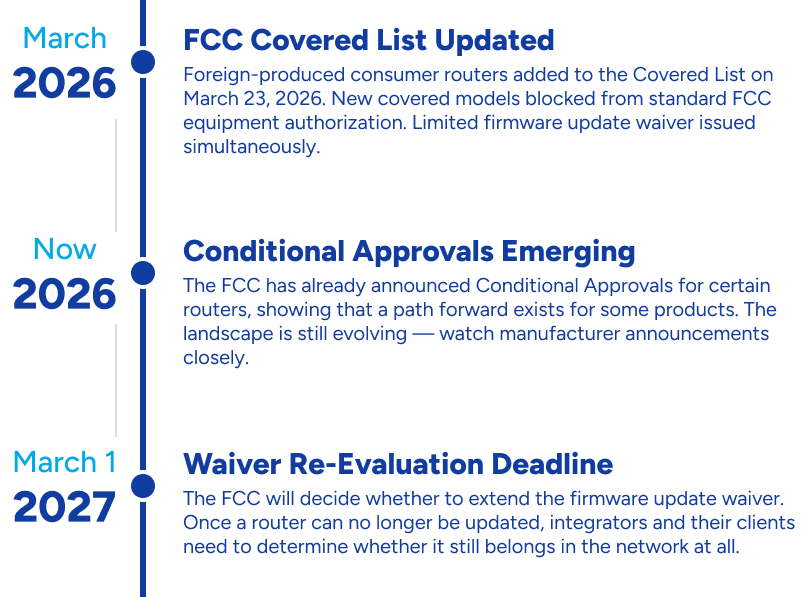
On March 23, 2026, the FCC added routers produced in a foreign country to its Covered List, except routers granted Conditional Approval by DoW or DHS. Once equipment is on that list, it cannot move through the standard FCC equipment authorization path. In practical terms, that blocks new covered models from entering the U.S. market the way they could before, unless they clear that separate approval process.
For integrators, this a forward-looking issue. The biggest effect is on fu ture covered models, future approvals, and future product planning.
This ruling did not prohibit the continued use of routers that were already lawfully purchased or previously authorized. The FCC’s fact sheet says the update does not prohibit the import, sale, or use of existing device models the FCC had already authorized before the March 23 change.
For the client sitting in a finished home, nothing changes overnight. For the integrator choosing what to specify next, quite a bit does.
Router Scope Screening Guide
Built and marketed as consumer or prosumer products for home use.
Products intended mainly for home use are in the frame.
Products that can be set up by the end user without a professional.
Production location is part of the FCC's framework.
Modem/router combos from an ISP can qualify if they meet the definition.
These models cannot move through the standard FCC equipment authorization path unless they receive conditional approval.
Products for professional or business environments may fall outside the covered category.
If the product is not mainly intended for home use, that matters.
Products requiring professional deployment and ongoing management may fall outside scope.
If the product does not meet that production criterion, it may fall outside scope.
Some routers may still move forward if they receive Conditional Approval
Many integrators are looking more closely at enterprise-grade managed-network platforms precisely because they fall outside this category.
The FCC is not talking about every router category across the market. The focus is on routers that are consumer-grade, primarily intended for residential use, customer-installable, and produced in a foreign country.
This is not just a residential-use question. Production location is part of the analysis too. The FCC FAQ also says ISP-provided residential gateways that combine modem and router functions can still fall within scope if they meet the definition.

The FCC says this update followed a national security determination that foreign-produced routers posed unacceptable economic, national security, and cybersecurity risks. The stated concerns include supply chain vulnerability and the possibility of severe cybersecurity risk, including covert access or backdoor risk.
Which brings up an important point: the government has decided this category raises enough concern to justify action.
That alone changes how these products should be evaluated. If the government is saying this product category presents that level of risk, some clients are going to look at their installed network differently, even if the law does not force immediate replacement.
Router selection is no longer just a conversation about speed, features, and price. It is also a conversation about supportability, sourcing, and what kind of uncertainty you want built into a client’s network over time.
This is one of the most important parts of the ruling for integrators.
On the same day as the Covered List update, the FCC’s Office of Engineering and Technology issued a limited waiver allowing routers authorized before the March 23, 2026 Covered List addition to continue receiving software and firmware updates that mitigate harm to U.S. consumers. That waiver originally ran through March 1, 2027. On May 8, 2026, the FCC extended it to at least January 1, 2029, and also broadened the scope of permitted updates. The extension expressly includes patches for vulnerabilities and compatibility fixes needed to maintain continued functionality.
The FCC has indicated it may continue to revisit the waiver before January 1, 2029. Still, from an integrator’s point of view, patching and long-term support questions are a big issue. Once a router can no longer be updated, integrators and their customers need to determine whether it still belongs in the network at all.

If a product line depends on new covered models coming to market, future availability matters more now than it did six months ago.

If a platform sits inside this covered category, firmware updates and long-term maintenance are a real consideration.

If you are planning around Wi-Fi 7, phased network upgrades, or multi-year residential standards, you do not want those plans resting on uncertain future approvals.

Even if a client is not legally required to remove existing hardware, that does not mean they will want to keep it once the government has identified the category as carrying unacceptable risk.

Most homeowners will never read an FCC notice. They are relying on you to recommend platforms that remain viable, supportable, and sensible over time.

This ruling poses a bigger question: does the product still belong in a premium residential offering if future approvals, patches, and product continuity all carry more uncertainty?
As CE Pro put it, the FCC action is “placing major router brands like Eero and Ubiquiti in the crosshairs.”
For integrators, that is a sign that some brands may be harder to navigate under this ruling, especially where consumer-grade residential hardware is involved. That makes support planning, future upgrades, and long-term vendor selection more important than before.
One likely result of this ruling is that more residential projects move away from consumer-grade hardware and toward professionally deployed, managed network platforms that sit outside the consumer-grade, residential, customer-installable category the FCC is targeting. CE Pro reported that some leaders in the CI channel see the ruling as potentially beneficial to the professional side of the market because it puts more scrutiny on consumer-grade gear and pushes attention back toward higher-end network design.
For some integrators, this may reinforce a shift already underway: away from consumer-grade residential routers and toward enterprise-grade platforms designed for professionally managed networks. That can include Cisco Meraki, which sits outside the consumer-grade residential category targeted by the ruling. SpecOp Secure exclusively builds its network solutions around that platform.
One reason this ruling has been tricky to interpret is that things have continued to evolve after March 23. The FCC has already announced Conditional Approvals for certain routers, which shows there is a path forward for some products rather than a single outcome for every device that fits the initial category.
That means integrators should avoid thinking that nothing has changed or that every covered product category is permanently closed off with no path ahead. The better approach is to keep watching the FCC record, watch what manufacturers say about support and future models, and make product decisions with a longer horizon in mind.
The FCC’s March 2026 router ruling is not a blanket order to rip out existing equipment. It is, however, a serious signal about how the government views the risk tied to certain foreign-produced consumer-grade residential routers, and it puts new pressure on future product availability, support, and long-term planning.
For custom integrators, that means the decision is no longer just about whether a router works today. It is also about whether that product still deserves a place in the network tomorrow, whether future patches and successor models will remain dependable, and whether clients are comfortable with that risk once it has been called out this plainly.
This ruling continues to evolve. On May 8, 2026, the FCC extended the software update waiver from March 1, 2027 to January 1, 2029. We update this post as the FCC record changes. Click here for the latest news on the FCC’s router ruling.
Note: This article is for informational purposes only and does not constitute legal or regulatory advice. Integrators with specific compliance or contractual questions should consult qualified counsel.
Share this post:
Follow us on our Social Media:

Annette Garcia-Acosta is Director of Communications at Decypher Technologies, where she leads content strategy and brand communications across the company’s cybersecurity and managed IT practices. Her work centers on making complex technical subjects clear and accessible for non-technical decision-makers, including the family offices and ultra-high-net-worth clients Decypher serves.
Before specializing in technology communications, Annette developed curriculum and exhibition materials for internationally recognized institutions, including the Ghetto Fighters’ House Museum in Israel and the Memorial and Museum Auschwitz-Birkenau. Her background spans technology communications, educational content development, and historical research.