Common Wi-Fi Problems in Large Homes and How to Fix Them

  • Home
  • Blog
  • Common Wi-Fi Problems in Large Homes and How to Fix Them
Common Wi-Fi Problems in Large Homes and How to Fix Them
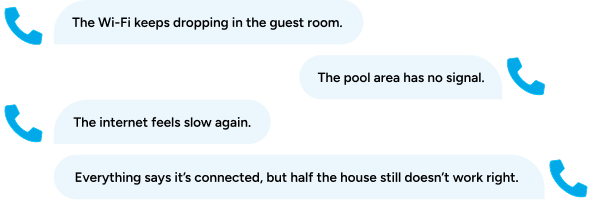
You’ve probably had these kinds of calls tons of times:

So you send a tech. They walk the property with a phone, look at bars, run a speed test in a few rooms, reboot a couple devices, maybe move an access point or swap one out.

Sometimes that helps. A lot of times it just costs you in labor.

Once you’re dealing with a large home, outdoor coverage, multiple access points, and a pile of connected devices, a phone only tells you what one device sees in one spot. It won’t show you channel overlap, rogue APs, hidden interference, failed 5 GHz coverage, or why the network feels slow even though the ISP speed test looks fine.

That’s where a proper Wi-Fi site survey changes the conversation. Instead of guessing, you can see where coverage drops, where interference builds, and where settings or hardware are working against you.

In this post, I’m going to walk through some of the most common Wi-Fi problems integrators run into, what usually causes them, what you can try first, and where a proper survey makes the answer a whole lot clearer.

Why Wi-Fi Coverage Fails Indoors and Outdoors

The client tells you the kitchen is fine, but the patio is dead. The office works most of the time, but the upstairs bedrooms don’t. The living room streams without a problem, but the pool house barely connects. 

That doesn’t always mean the whole network is bad. A lot of the time, it means the coverage pattern doesn’t match how the client is using the space. 

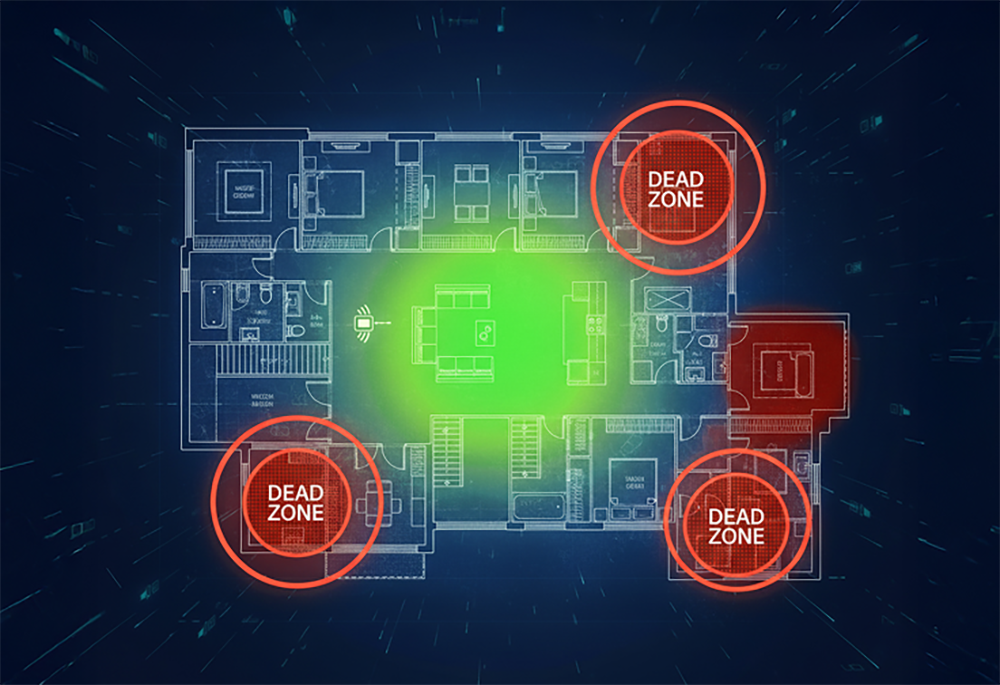
A proper Wi-Fi coverage report shows where signal is strong, where it fades, and where it drops out. That matters because weak coverage and no coverage are different problems, and they need different fixes. 
What you can try to fix Wi-Fi coverage

How a SpecOp survey makes this easier

Those first checks can help you rule out the obvious stuff. The problem is that they still don’t tell you whether you’re dealing with a dead AP, a bad placement decision, or a coverage gap that was built into the design from day one. 

A SpecOp survey gives you that answer much faster. Your tech walks the property, we review the data, and you get a heatmap that shows whether the issue is hardware, placement, or missing coverage. That keeps you from moving gear around blindly or adding an AP where it won’t solve the real problem. 

What a Wi-Fi Heatmap Shows When Coverage Is Missing

When a Wi-Fi heatmap shows white, grey, or clearly dead areas, that tells you something useful right away. The signal is not just weak: it’s either missing or unusable. 

That usually points to one of a few things: 

What you can try when a Wi-Fi heatmap shows dead zones

How a SpecOp survey makes this easier

Those checks help you rule out the obvious stuff, but they still leave a lot of room for guesswork. A SpecOp survey gives you a heatmap you can trust, so you can see whether the dead zone points to failed hardware, a bad cable path, poor AP placement, or a coverage gap in the original design. That makes it much easier to fix the right problem first instead of chasing three or four possibilities.

Why Wi-Fi Is Slow or Unresponsive Sometimes

This is one of the hardest complaints for clients to describe, and one of the easiest for integrators to get stuck on. 

The client says the internet feels slow, but the ISP speed test looks fine. Devices connect, but apps stall; streaming buffers for no obvious reason; calls freeze; web pages hang halfway through loading. 

That kind of problem often has very little to do with raw internet speed. 

It can come from: 

What you can try when Wi-Fi feels slow

How a SpecOp survey makes this easier

A SpecOp survey helps show the actual cause of the slowdown. Once we review the data, you can see whether the slowdown is coming from channel interference, retries, roaming behavior, congestion, or rogue devices. That matters because the fix for bad channel planning is completely different from the fix for sticky clients or too many devices fighting for airtime. 

How Channel Interference Causes Wi-Fi Problems

This is one of the most common problems in larger homes. 

Multiple APs end up sitting on the same channel, especially in 2.4 GHz. The signal may still look strong, but performance suffers because those APs are competing for the same airtime. 

In condos and MDUs, it gets worse because your APs may also be competing with nearby networks stacked onto the same few channels. 

What you can try to fix channel interference

How a SpecOp survey makes this easier

A controller can tell you part of the story, but it won’t always show how the interference is playing out in the actual space. A SpecOp survey shows where APs are colliding, where co-channel interference is strongest, and whether the problem is your channel plan, the neighbor’s network, or a rogue device the client added later. That gives you a much cleaner path to the fix. 

How the Wrong Channel Width Hurts Wi-Fi Performance

Channel width gets ignored all the time, and it causes more trouble than people realize. 

If the channel width is too wide for the environment, the network creates unnecessary interference and eats up spectrum it doesn’t need. If it’s too narrow, you may be limiting performance where the environment could support more. 

The right setting depends on the job. House size, neighboring networks, outdoor overlap, device density, and how many APs are in play all matter. 

What you can try to fix channel width problems

How a SpecOp survey makes this easier

Channel width is one of those settings that looks small in the controller and causes outsized problems in the field. A SpecOp survey ties the recommendation to the actual RF environment, so you’re not making channel-width changes based on guesswork or on a template that doesn’t fit the property. 

How Rogue APs Create Hidden Wi-Fi Interference

Rogue APs are one of the easiest ways to mess up a clean design without realizing it. 

You finish the job, the network is stable, and then a printer, camera, ISP modem, or random consumer gadget starts broadcasting its own SSID. Now your carefully planned channels are sharing airtime with equipment you didn’t install and may not even know exists. 

Common rogue APs include: 

printers with Wi-Fi Direct enabled

cameras with
setup SSIDs

ISP modem/router Wi-Fi left turned on

consumer extenders or routers added after your install

What you can try to fix rogue AP problems

How a SpecOp survey makes this easier

A phone walkthrough won’t tell you that the printer in the office is broadcasting on top of three of your APs. A SpecOp survey will. We can see which extra SSIDs are in the air, where they are causing interference, and how they are colliding with your design. 

How Bad AP Settings Break a Good Wi-Fi Network

Sometimes the hardware is fine. The placement is mostly fine too. The real problem is in the settings. 

We see issues like: 

transmit power set too high

radios left on where they don’t belong

radios turned off where they’re needed

channels left on auto in environments where that causes conflicts

security settings or roaming settings that don’t match the deployment

These are the jobs where the client says the network is mostly good, but certain devices behave badly, roaming feels odd, or performance changes depending on where they stand. 

What you can try to fix bad AP settings

How a SpecOp survey makes this easier

It’s one thing to know the network feels off. It’s another to know exactly which radios, channels, and power settings need to change. SpecOp survey gives you that context, so you’re making controller changes purposefully. 

How Wi-Fi Security Settings Affect Performance

Security settings are part of Wi-Fi performance whether people think of them that way or not. 

If the network’s security settings are outdated or poorly matched to the environment, that can affect both protection and usability. Some settings strengthen the network. Some can create compatibility issues if they’re rolled out without thinking through the client’s device mix. 

One example is Management Frame Protection. In the right environment, it helps protect against spoofing attacks like deauthentication and disassociation. It can also improve reliability in networks where those issues matter. But older devices may not always handle it well, so this has to be reviewed in the context of the whole network. 

What you can try to fix Wi-Fi security setting issues

How a SpecOp survey makes this easier

A good troubleshooting review should catch this too. Coverage and speed matter, but stability and security belong in the same conversation. When we review the survey and the network behavior together, it becomes easier to spot where a security setting may be helping, where it may be causing compatibility issues, and what to change without creating a new problem. 

Why SpecOp Secure Approaches Wi-Fi Troubleshooting Differently

Once you know what kind of problem you’re dealing with, the next challenge is getting to the answer without wasting half a day chasing the wrong thing. 

That’s where we come in. 

Our process is built to help integrators get from “the Wi-Fi is acting up again” to “here’s what’s wrong and here’s what we’re changing.” 

Here’s the workflow: 

That report can include: 

Click the image to view in larger size:

Click the image to view in larger size:

Click the image to view in larger size:

In plain language, we help you walk back in with proof, a plan, and a report your client can understand.

What a Wi-Fi Coverage Report Gives You

A good Wi-Fi coverage report does more than circle weak areas on a map. 

It shows: 

That may mean:
Basically, this report gives you a path forward.

How to Troubleshoot Wi-Fi Problems the Right Way

Most Wi-Fi problems are not random. 

Dead zones, poor coverage, slow performance, same-channel interference, oversized channels, rogue APs, and bad AP settings all leave evidence behind. The problem is that you don’t see much of that evidence by walking around with a phone. 

A proper Wi-Fi site survey and coverage report let you stop guessing and start working from data. 

That gives you a better troubleshooting process now. It also gives you a stronger path to upgrades, redesigns, and longer-term support. 

The more visibility and support structure you have around the network, the less time you spend chasing the same issues over and over. 

Need help troubleshooting a problem Wi-Fi network?

If you’ve got a project where the Wi-Fi still isn’t right and the usual fixes aren’t getting you anywhere, let’s talk it through. 

Book a call with Ted and we’ll look at the job, the symptoms, and the best way to get to the real cause. 

FAQ: Common Wi-Fi Problems and How to Fix Them

A coverage issue usually shows up as weak or missing signal in a specific area. Interference shows up when the signal looks strong, but performance is still bad. A Wi-Fi heatmap and site survey help separate the two. If the signal is missing, you’re looking at a coverage problem. If the signal is there but the network still struggles, interference, channel overlap, or bad settings are usually involved.

Because slow Wi-Fi and slow internet are not always the same problem. You can have a strong ISP connection and still have poor Wi-Fi performance because of channel interference, bad channel width, high retries, rogue APs, or devices hanging onto the wrong access point.
A rogue AP is any wireless access point or device broadcasting Wi-Fi that you didn’t plan for as part of the network design. Common examples are printers with Wi-Fi Direct enabled, cameras broadcasting setup SSIDs, ISP modem/router Wi-Fi left turned on, or consumer extenders added after the install.
Start by checking whether there is already an AP meant to cover that area. If there is, confirm it has power, is connected, and is actually working. If the hardware is fine, the issue may be AP placement or a design gap. A coverage heatmap will tell you whether the space needs a replacement AP, a relocated AP, or an additional AP.
Channel interference happens when multiple APs are broadcasting on the same or overlapping channels. That can come from your own network, neighboring networks, or rogue devices in the home. It is especially common in 2.4 GHz and in dense environments like condos or homes with a lot of client devices.
A site survey and RF analysis will usually show it. If the channel width is too wide, it can create unnecessary interference. If it is too narrow, you may be limiting performance. The right setting depends on the environment, the AP density, and how much neighboring Wi-Fi is competing for airtime.

Yes. We see it all the time. Power set too high, radios left on where they shouldn’t be, channels left on auto, or security and roaming settings that don’t fit the environment can all make a solid network behave badly.

Not every time, but if you are dealing with repeat complaints, inconsistent performance, dead zones, or a large home with multiple APs, a site survey will usually save time. It gives you real data instead of another service visit built around trial and error.
Your tech runs the survey, and our engineering team reviews the file in Ekahau Pro. We turn that data into a client-ready report with heatmaps, findings, and specific recommendations. That gives you a clearer troubleshooting path and something solid to put in front of the client.
Yes. Once you have real data and a clear fix plan, it becomes easier to justify upgrades, redesigns, and ongoing support. That’s one reason troubleshooting often opens the door to stronger managed network relationships.

Share this post:

Facebook
Twitter
LinkedIn

Follow us on our Social Media: