

I’m still recovering from CEDIA. Great week, but a full one (IYKYK). I don’t know about you all, but I felt CEDIA this year was totally different from the show floors of the past. It wasn’t only the fact that there were (a lot) fewer attendees. I think it was the feeling in the air that our industry is undergoing a real shift. Some integrators were negative about the future of the channel, but the majority felt that this was a time for adaptation, for growth.
I’m with the majority. Successful integrators will be the ones who adapt and innovate, who understand their clients’ pain points before their clients can even name them, who show the value they can bring even to the most ardent DIY-er homeowner.
And like every year, the best part was the conversations, getting to sit down with integrators about what’s going on in their businesses.

Henry Clifford
Founder & CEO, Livewire
I talked with Henry Clifford (founder and CEO of Livewire), who runs Cyber Protect in his own home. He told me about the time he had to briefly disconnect his network to get it onboarded, family home and all, which is a nervy thing to do in a house full of people who notice the second the Wi-Fi blinks (now, that’s one brave man). His verdict? It never knocked out his signal and all looks great so far.

Wade Legette
President, LeggeteTech
I caught up with Wade Legette, president of LeggeteTech, about adding cybersecurity to his lineup, and no matter where the conversation started, it kept coming back to RMR and how much recurring revenue a security offering can build.

Carlos Silva & José Jiménez
BlueSky Audio Video · HOMETEKMEDIA
And I had a genuinely good back-and-forth with Carlos Silva of BlueSky Audio Video and José Jiménez of HOMETEKMEDIA about the education gap around cybersecurity, and a simple truth that’s hard to argue with: integrators can’t sell what they don’t understand yet.
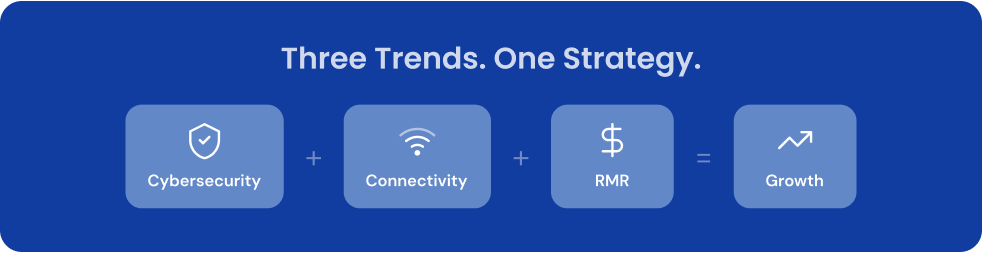
Those three conversations turned out to be a pretty good map of the whole show. When I step back and look at what integrators from all over were asking about, it comes down to three trends, and all of them run straight toward recurring revenue. Here’s what stood out, and what each one means for your business.
Trend 1:
Cybersecurity Is Now a Core Integrator Offering

Cybersecurity was everywhere at CEDIA this year. It was one of the most heavily programmed topics on the education schedule, and a lot of those sessions weren’t about how to configure a firewall. They were about how to talk to your clients about cyber hygiene and network security.
That focus tells you where the market is. Your clients are already hearing about ransomware and breaches, and more of them are asking you what you’re doing to protect them. The problem, and this is exactly what Carlos and José and I kept talking about, is that it’s hard to sell something you haven’t had the chance to fully learn. Cybersecurity is its own discipline, and most integrators came up through AV rather than network security.
Here’s the good news: you don’t have to become a security expert to start offering it. With SpecOp, you build Cyber Protect into every network proposal as a default line item, and we handle the engineering and monitoring behind it. Our Integrator’s Liability Waiver Cheat Sheet shows you how to structure it so a client has to sign if they want to opt out, which moves liability off your plate and onto a documented decision. It protects you and your client, and it adds recurring revenue to a proposal you were already writing.
And if your team wants to get comfortable with the material first, we’ll set up a training for your sales and technical people at no cost. Closing that education gap is the whole idea.
How SpecOp Closes the Cybersecurity Gap
Trend 2:
Reliable Connectivity Is the Foundation of the Connected Home

The homes you’re building keep getting more connected. More automation, more AI in the rack, more energy management, more devices that all assume the connection underneath them just works. That was a clear theme in Denver. As everything else gets smarter, connectivity stops being one system among many and becomes the thing the entire experience depends on, whether that’s the Wi-Fi carrying the data or the cell signal carrying the call.
You already know this from the service calls. When a client rings you six months after the install, it’s rarely about the gear you were proud of. It’s the Wi-Fi calling that drops in the primary suite, or the dead spot where the cell signal should be. Those callbacks eat your margin and quietly shape how the client remembers your work. Reliability isn’t a line on a spec sheet. It’s the client’s whole impression of you.
This is where SpecOp’s network solutions come in. You can quote them as a monthly NaaS or sell the equipment outright, and either way our engineers design the system and get it commissioned, so the recurring revenue sits right alongside the reliability your client can experience.
For the cellular dead spots that Wi-Fi calling can’t fully fix, our cellular amplification systems fix weak signal at the source, starting under $10,000 retail for a 5,000-square-foot home. Different problem from the network, same payoff for you: a client who isn’t calling you about dropped calls, and another line you can bill monthly.
Trend 3:
Recurring Revenue (RMR) Is Now the Business Model

If there was one idea running underneath every business session at CEDIA, it was recurring revenue. Service contracts, managed services, subscription models, all of it pointing the same direction. And the numbers back it up. Across the integration and security space, recurring monthly revenue now makes up roughly 38.5% of total industry revenue, up from about 33% just two years ago (Security Sales & Integration). That shift isn’t slowing down.
You already understand why. Project revenue is lumpy. You win the job, you do the work, and then you’re back out hunting the next one. RMR is the revenue you can count on without re-winning it every month, and it does more than smooth out cash flow. It builds the long-term value of your business and keeps you connected to your clients between projects instead of only showing up when something breaks. If you want the deeper case for it, we broke it all down in RMR 101.
This is really the thread that ties the first two trends together. Cybersecurity, networks, cellular amplification, every one of them is engineered to layer recurring revenue onto work you’re already doing. That was Wade’s takeaway at the booth, and it’s the same conclusion most integrators reach once they run the math. You keep the client relationship. We handle the technical side. And the monthly revenue builds on projects you’d be selling anyway.
The integrators who are going to grow over the next few years are the ones who stop treating cybersecurity, reliable networks, and recurring revenue as separate decisions and start treating them as one strategy. That’s the shift CEDIA 2026 made hard to ignore.
That’s also exactly what we’re built to help you do. SpecOp handles the engineering and the ongoing support, so you can offer more to your clients without becoming an expert in all of it yourself.
If any of this is on your mind coming out of the show, reach out to Ted and we’ll talk through where it fits for you. And if your team wants the education piece first, we’ll set that up too. No reason to leave the revenue, or the reliability, on the table.

Annette Garcia-Acosta is Director of Communications at Decypher Technologies, where she leads content strategy and brand communications across the company’s cybersecurity and managed IT practices. Her work centers on making complex technical subjects clear and accessible for non-technical decision-makers, including the family offices and ultra-high-net-worth clients Decypher serves.
Before specializing in technology communications, Annette developed curriculum and exhibition materials for internationally recognized institutions, including the Ghetto Fighters’ House Museum in Israel and the Memorial and Museum Auschwitz-Birkenau. Her background spans technology communications, educational content development, and historical research.